 For e-Mobility Service Providers
OCPPLab
Validate roaming end to end — OCPI negotiation, tokens, and CDR flows across every partner — before you sign the contract.
 Station F
 EDHEC Entrepreneurs
Who we are
OCPPLabWho we are

Oumaima Bounouadar
Co-founder & Data Scientist
5+ years in AI, data and software products. Focused on AI and machine learning for eMobility, product strategy and go-to-market, automation, analytics and decision systems.

Yassine Elazrak
Co-founder & Staff Engineer
6+ years in software engineering. Focused on OCPP and OCPI platform development, distributed systems and cloud infrastructure, and EV charging software architecture.
“This problem showed up firsthand — this is the platform operators wished existed.”


Current problem
OCPPLabTesting without hardware
Teams still depend on physical chargers, vehicles and sites to validate integrations. Testing becomes slow, expensive and difficult to reproduce.
Manual & expert-driven testing
Critical validation workflows remain manual and concentrated in a few protocol experts, creating bottlenecks across engineering teams.
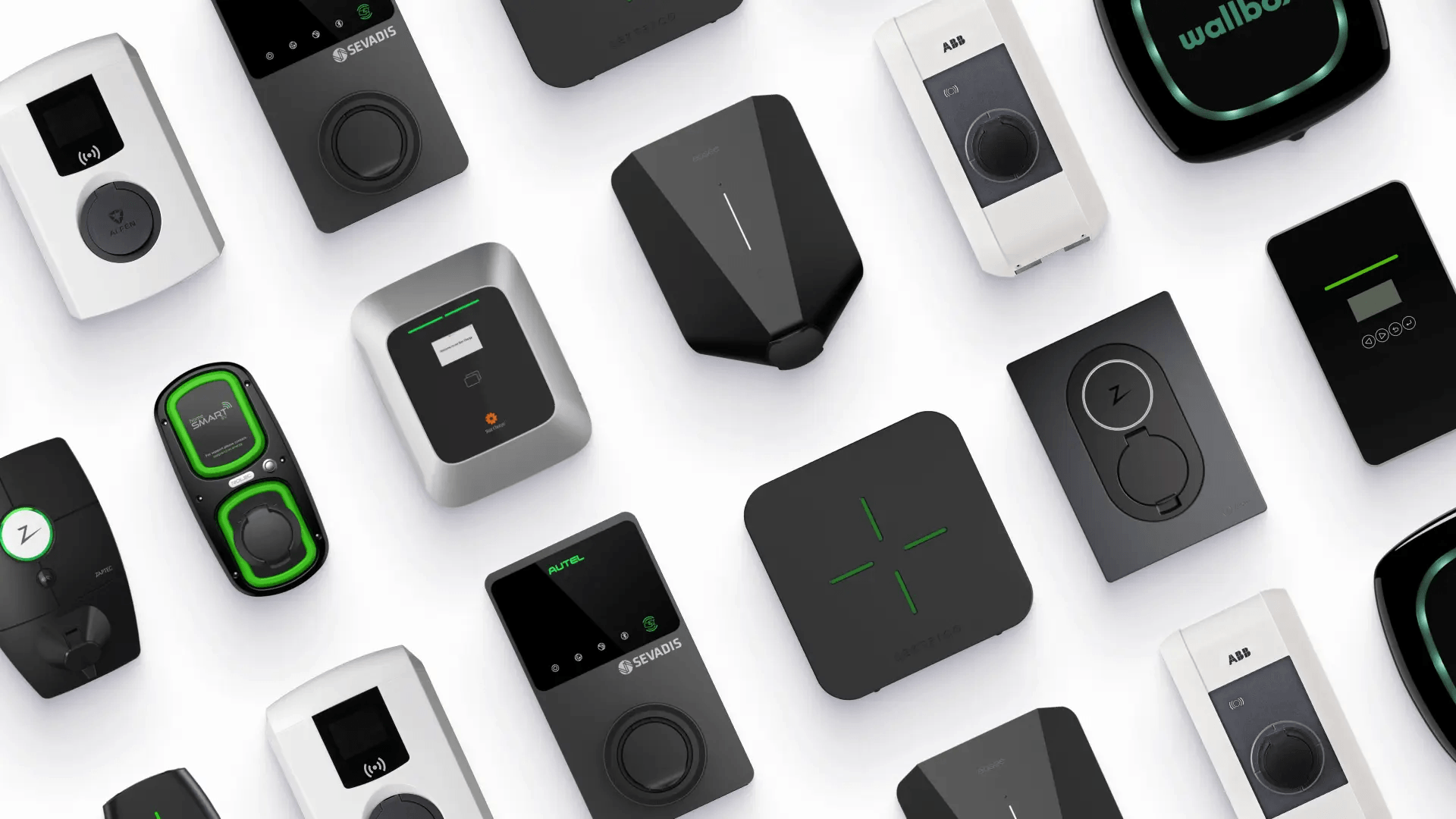
EV interoperability remains manual, hardware-dependent and difficult to scale.
Physical labs, protocol experts and fragmented tools slow down deployments, increase costs and delay integrations across the EV ecosystem.
Multi-vendor interoperability
Every charger manufacturer behaves differently. Validating dozens of firmware versions and vendor-specific implementations does not scale manually.
Roaming & partner onboarding
Integrating a new CPO, eMSP or roaming partner requires weeks of coordination, protocol validation and certification preparation.
Market opportunity
OCPPLabA growing software-driven industry
OCPPLab focuses on the interoperability, validation and continuous testing layer.
TAM
2030$7.5B
Global EV Charging
Management Software Market
Europe
Estimated€1–1.5B
European Software
Opportunity
OCPPLab
Initial SOM€1–3M ARR
OCPPLab Initial SOM
3-year commercial target
Sources: Grand View Research, IEA Global EV Outlook 2024, EAFO, ACEA
For e-Mobility Service Providers
OCPPLabOnboard roaming partners in days, not weeks
Test OCPI end to end — tokens, locations, sessions and CDRs — against every partner before you go live.
OCPI roaming testing
Validate OCPI 2.1.1 and OCPI 2.2.1 flows against CPOs and hubs without waiting on partners.
Partner sandbox
Give each new CPO a reproducible environment to certify against.
CDR reconciliation
Catch billing and CDR mismatches before they reach your drivers' invoices.
Driver-grade flows
Exercise authorize, start, stop and pricing exactly as the driver app would.
What OCPPLab does
OCPPLabOne platform for the entire interoperability lifecycle.
From virtual chargers and automated workflows to roaming validation, observability, CI/CD and multi-environment routing.
Virtual charger fleets
Simulate hundreds or thousands of chargers without hardware.
Automated workflows
Run repeatable OCPP and OCPI test scenarios on demand.
Roaming validation
Prepare partner onboarding, OCPI certification and roaming flows.
Observability & debugging
Centralize logs, diagnose failures and understand protocol behavior.
Multi-brand compatibility
Validate charger brands, firmware versions and protocol variants.
Continuous integration
Embed interoperability testing into CI/CD pipelines and validate every release automatically.
Multi-environment routing
Connect one charger to multiple backends across development, testing and production.
Edge case simulation
Validate rare, complex and failure scenarios before production deployment.
Scalability testing
Stress-test charging infrastructures and large fleets under realistic load.
OCPI roaming scalability
OCPPLabOne eMSP, every CPO network
An eMSP, app and wallet reach CPO networks 1, 2 and 3 through a single OCPPLab proxy — no point-to-point integration per partner.
Every OCPI version, end to end
The proxy speaks OCPI 2.1.1, 2.2.1 and 2.3.0 to partners and OCPP 1.6, 2.0.1 and 2.1 to networks — version gaps reconciled in one place.
Tokens, billing & CDRs in one path
Token A/B/C auth, billing and CDR delivery run through the same proxy, so adding a CPO network scales the roaming footprint without rewiring.
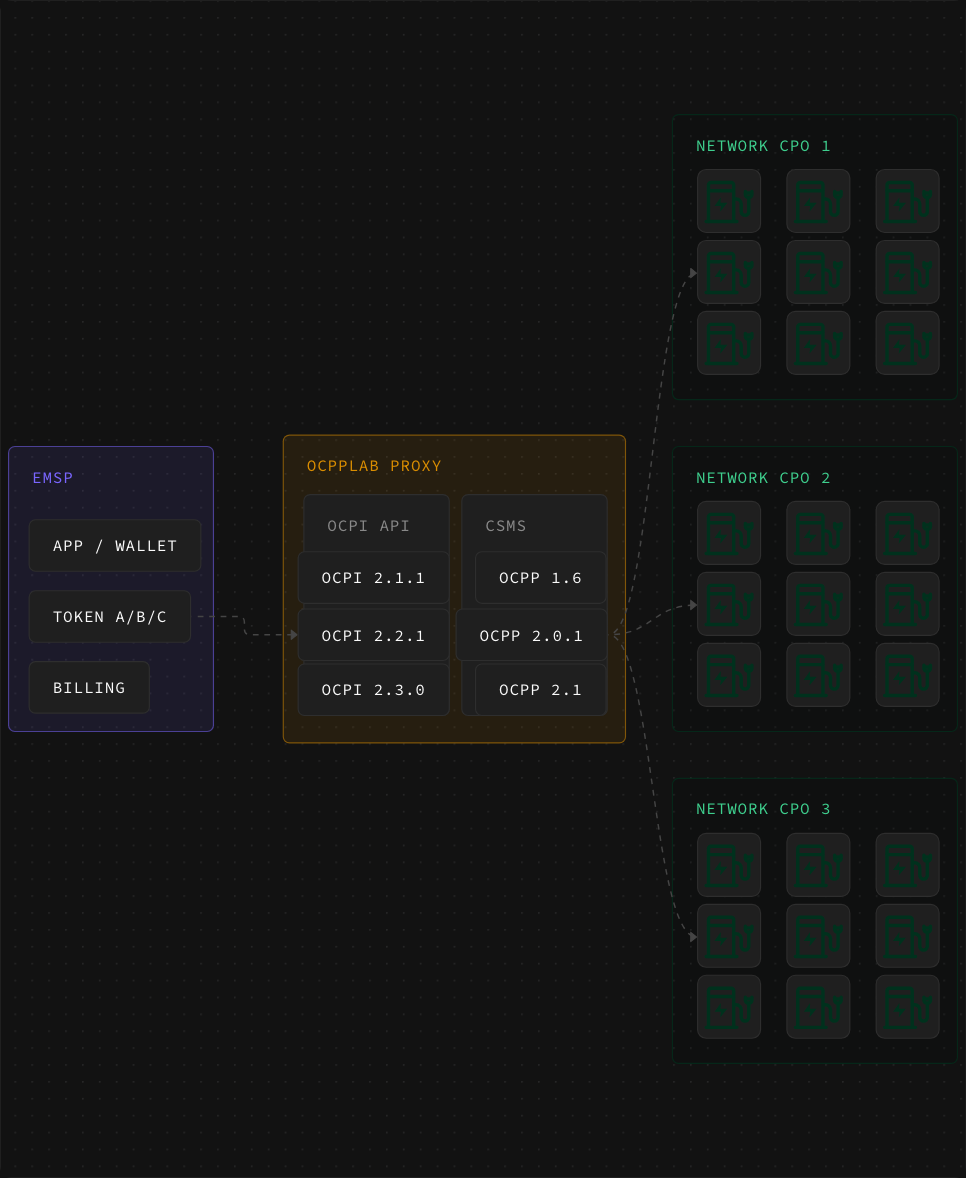
ONE PROXY BROKERS EVERY eMSP TO EVERY CPO NETWORK
ROI & business impact
OCPPLabFrom manual testing to continuous validation
Without OCPPLab
- Hardware-dependent validation
- Manual testing and regressions
- Repeated partner integrations
- Production-discovered issues
- Slow charger onboarding
- Expert-driven workflows
With OCPPLab
- Virtual charger environments
- Automated test workflows
- Continuous interoperability testing
- Earlier issue detection
- Faster partner onboarding
- Scalable validation across teams
Projected impact
€200k+
Estimated annual interoperability testing costs
(illustrative scenario based on internal modelling)
Days → Minutes
Validation cycles accelerated through automation
10x+
Potential ROI
(compared to traditional hardware-dependent testing workflows)
More coverage. Less effort. Earlier detection.
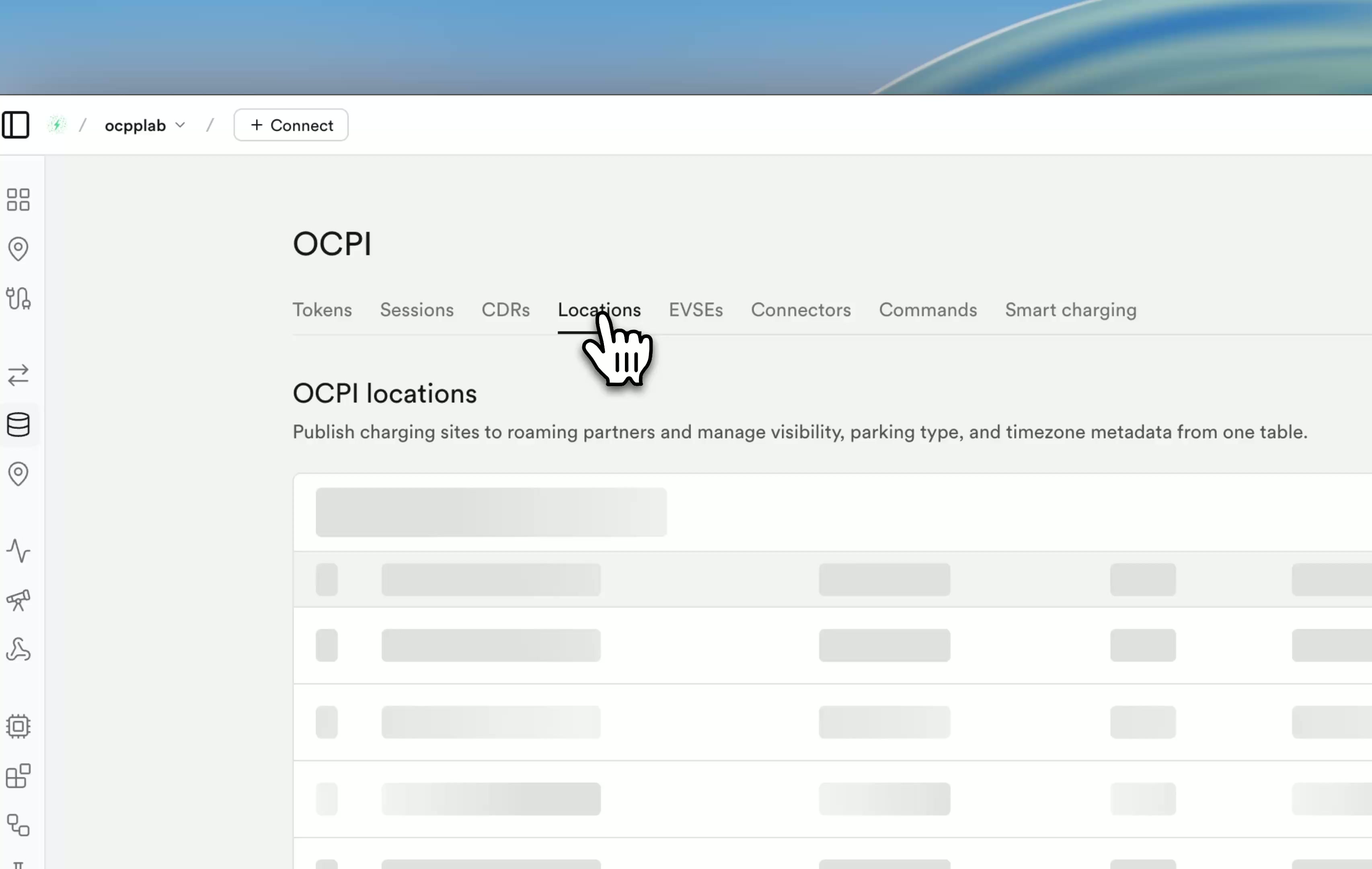
Demo — Charging Management Platform (Private beta)
OCPPLabSilent walkthrough of the OCPPLab charging management platform: virtual chargers, protocol workflows, and live session debugging.
Contact
OCPPLabValidate Your Charging Stack Together.
Schedule a walkthrough and see how OCPPLab can test OCPP, OCPI, roaming and production-scale edge cases before they hit your users.